


I look up at the night sky, with no city lights to mar your gaze, and the stars spread out across the infinite sky. To me, it looked like they arranged themselves into shapes that whispered tales. That discovery, however, is believed to have kick-started how our ancient ancestors found out about astrology: celestial bodies influence human life and earthly events.
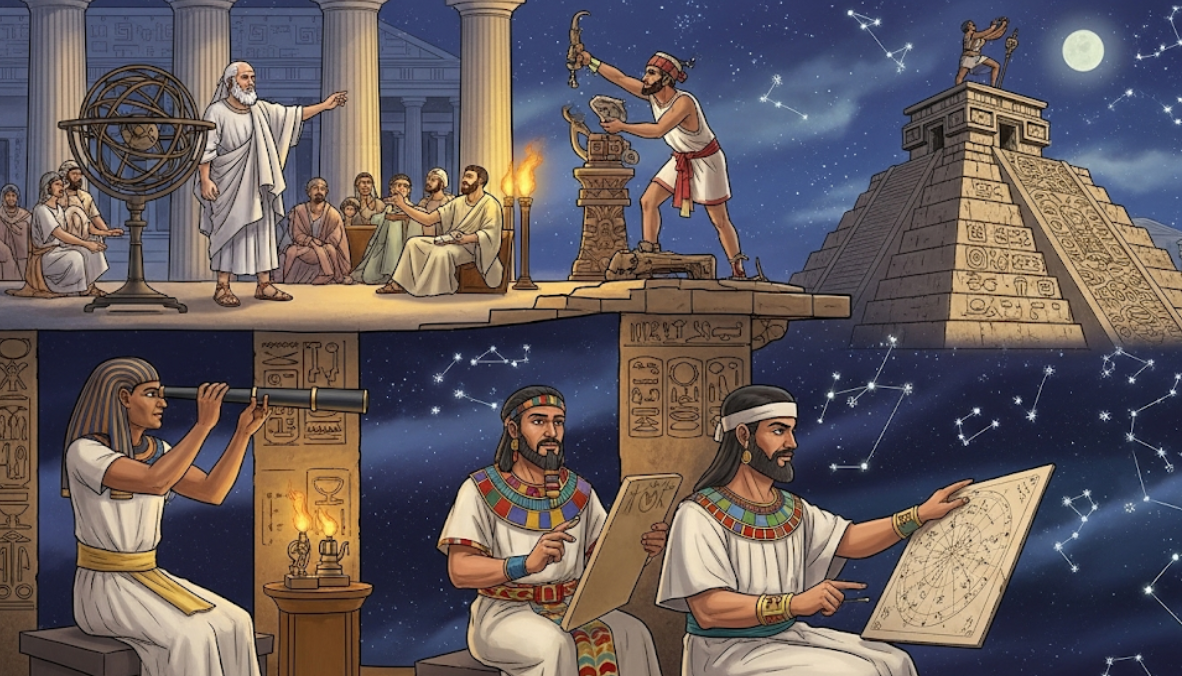
There was once a time when the ancients relied on the stars for direction—a long, long time before smartphones and weather apps. Astrology was heavily relied upon for everything from decisions about marriage and money to seeing how an individual fit into the cosmos. From pharaonic rule of Egypt to the hanging gardens of Babylon, philosophy owned by stars and their own tale of contemplating themselves in place.
In this compelling voyage through time, bestselling author Nicholas Campion explores the history of how the perfection of star patterns and planetary rhythms to which we have been in thrall ever since, determined our calendar and guided our interpretation of events on the Earth. In this article, we will look closer at some other cultures across the world and how they created focused types of astrological systems that worked in their lives and still influence us today.
The Origin of Astronomy: Our First Glimpse Into the Stars
Born as Stargazing
Astrology began eons ago around 3000 BCE when early human civilizations started realizing that their landform and some astronomical star patterns were repeating at a certain time of the year. These were survival skills, not just observations for amusement.
How Did Our Ancient Ancestors Use Star Gazing?
Ancestors of late humans noticed that cosmic events interconnected with significant beings in the world:
Timing: Specific stars helped ancient people know when they had to plant or get ready for cold weather.
Flood Prediction: River civilizations learned to use them to anticipate annual floods that kept their life-giving rivers within their courses.
Navigation: Travelers sailed their way using constellations as celestial compasses.
Spiritual Rituals: Star positions were used to pick significant ceremonies on certain days.
The First Star Calendars
Before the advent of written language, ancient people established star calendars by:
Stone Circles: Sites such as Stonehenge were built in symmetry with certain cosmic occurrences.
Cave Paintings: The earliest records of the sky that we have come from paintings on cave walls.
Bone Carvings: Old scratching dating back to Ice Age animal bones reveal ancient lunar calendars thousands of years old.
Temple Alignments: Ancient sacred sites were positioned to sync with the heavens.
Mesopotamian Mastery: The Cradle of Western Astrology
Many of the principles and teachings associated with Western astrology can be traced back to ancient Mesopotamians (located in present-day Iraq). They invented highly advanced systems between 3000-500 BCE which are still used today.
Babylonian Breakthroughs
The Babylonians made several revolutionary contributions to astrology:
Zodiac Signs: Dividing the sky into 12 zones, one for each personality and life category. And so it becomes the zodiac we have come to know.
Planet Tracking: Babylonian astronomers tracked five naked-eye planets around the Earth:
- Mercury (associated with communication)
- Venus (the planet of love and beauty)
- Mars (related to war and conflict)
- Jupiter (representing luck and expansion)
- Saturn (symbolizing discipline and limitation)
Birth Charts: Horoscopes being drawn by plotting the position of the planets at the time one was born.
Enuma Anu Enlil: Ancient Astrology Textbook
The exact number of celestial omens was recorded on almost 7,500 tablets. It included predictions like:
- “If the moon turned red, it is a sign that rebellion is on its way to the king.”
- “Venus vanishing for 3 days begets a famine.”
- “When Jupiter is in the vicinity of Leo… success in war.”
Daily Life Applications
More than just astrology of kings and priests, common people used it for:
Selecting Wedding Dates: Couples visited astrologers to determine auspicious days.
Commercial Decisions: Traders scheduled key transactions when the planets happened to be in right positions.
Medical Treatment: Doctors thought some illnesses were due to the heavens.
Farming Activities: Following lunar cycles from planting to harvesting.
The Egyptian Aspect of the Stellar Gods
Astrology first came to being in ancient Egypt, and their system is one of the most advanced astrology systems created by humans. Egyptian priests and astronomers produced detailed star maps over the course of history (3100-30 BCE) that served as templates for pyramid construction and royal affiliation.
The Egyptian Star Calendar
The Egyptians developed a calendar of 365 days based on the heliacal rising of Sirius, the brightest star in the night sky. The annual flooding of the Nile was triggered by this event, happening at exactly the right time for agricultural planning.
Key Features of Egyptian Astrology:
- Decans: The year was broken into 36 ten-day periods, each ruled over by a star
- Star Clocks: Painted on tomb ceilings to assist the deceased in passing through the afterlife
- Planetary Hours: Each hour of day was ruled over by a different planet
- Pyramid Alignments: Corresponding with star positions and sacred geometry
Gods in the Sky
The Egyptians observed their gods as personified by the stars:
- Ra (Sun): Life, power, kingship
- Thoth (Moon): Wisdom, writing, judgment
- Isis (Sirius): Magic, motherhood
- Horus (Mars): War
- Ptah (Venus): Creation, craftsmanship
Pyramid Power: Architecture Meets Astrology
Egyptian astrologers realized this and the enormous size of the Great Pyramid of Giza was built to represent stellar alignments:
- Orion Alignment: Shafts point toward Orion constellation, representing Osiris
- Polar Star: Passages align with the pole star, providing eternal guidance
- Seasonal Marker: The pyramid acts as a colossal sundial throughout the year
Mummification and the Stars
Astrology was definitely part of the spiritual landscape within Egyptian burial practice:
- 70-Day Process: Mummification took 70 days, matching the absence of Sirius from the sky
- Star Maps: Rich Egyptians were buried with star maps in their burial chambers
- Canopic Jars: Internal organs were placed according to the four cardinal points and their corresponding ruling stars
The Greek Philosophers: Understanding the Need for Both Logic and Mystic Wisdom
It was not until the ancient Greeks (800-146 BCE) took astrology from an observational practice and turned it into a philosophical system. For centuries, theories that informed Western thought involved a blend of rational, mystical, and magical interpretations.
Greek Innovations in Astrology
Mathematical Precision: The Greeks used geometry and mathematics to form star charts and predictions with greater accuracy.
Personality Theory: Birth time and location were determined to develop personality traits—the same basis for contemporary horoscopes.
Medical Astrology: Classical physicians like the Greek physician Hippocrates practiced medical astrology, believing that each sign of the zodiac ruled over a certain region of the human form.
Famous Greek Astrologers
Ptolemy (100-170 CE): Wrote Tetrabiblos, which included:
- Detailed explanations of planetary influences
- Methods for interpreting birth charts
- Guidelines for making predictions
Hipparchus (190-120 BCE): Determined the precession of equinoxes; why stars shift over centuries.
The Four Elements System
Astrology connected to their theory that the world was made up of four elements:
- Fire (Aries, Leo, Sagittarius): Hot and dry
- Earth (Taurus, Virgo, Capricorn): Cold and dry
- Air (Gemini, Libra, Aquarius): Hot and wet; intellectual
- Water (Cancer, Scorpio, Pisces): Cold and moist; emotional
Greek Astrology in Politics
Greek city-states used astrology for:
- Elections: Important elections were held with good planetary positions
- Military Strategy: Astrologers consulted by generals before major wars
- Colonization: Stellar-synchronized set-up of new colonies
- Trade Negotiations: Diplomatic deals were inked under auspicious circumstances
China’s Political System: A Model of Celestial Harmony
Individual Chinese systems emerged from this tradition, each focusing upon a particular way of achieving balance and harmony with the cosmos.
Chinese Zodiac Animals: 12-Year Cycle
The Western zodiac is based on months, while Chinese astrology is based on a 12-year cycle:
| Year | Animal | Traits |
|---|---|---|
| Rat | First | Clever, adaptive, smart |
| Ox | Second | Diligent, dependable, reserved |
| Tiger | Third | Brave, competitive |
| Rabbit | Fourth | Wise, empathetic |
| Dragon | Fifth | Helpful, rise to the occasion |
| Snake | Sixth | Strong-willed, conservative |
| Horse | Seventh | Happy, energetic |
| Goat | Eighth | Friendly, accepting, calm |
| Monkey | Ninth | Smart, curious |
| Rooster | Tenth | Foresighted |
| Dog | Eleventh | Loyal, humble |
| Pig | Twelfth | Understanding, easygoing |
Five Elements Theory
Chinese astrology has five elements in a creative cycle: Wood → Fire → Earth → Metal → Water → Wood
All components affect personality, physical well-being, and life circumstances:
- Wood: Growth, creativity, flexibility
- Fire: Passion, energy, transformation
- Earth: Stability, nurturing, balance
- Metal: Precision, organization, justice
- Water: Wisdom, intuition, adaptability
Emperor and Heaven in Astrology
According to the Chinese emperors, their authority was divinely recognized with celestial assent:
- Imperial Astronomers: Interpreted omens for the emperor
- Solar Eclipses: Believed to indicate the emperor was weakening
- Comets: Predicted future shifts in leadership
- Strange Star Formations: Cosmic alarms indicating natural disasters or uprisings
The Forbidden City Layout
It exemplifies Chinese administrative architecture as a reflection of Heaven:
- Cardinal Directions: Buildings faced celestial constellation directions
- Room Arrangements: Matched constellation patterns
- Garden Designs: Incorporated astrological symbolism
Feng Shui: Astrology Meets Architecture
Building design followed feng shui principles based on Chinese astrology:
- Directional Orientation: Buildings faced particular directions to optimize energy flow
- Construction Timing: Groundbreaking ceremonies happened during good times
- Interior Design: Spaces followed astrological principles
- Landscape Integration: Gardens and water features enhanced celestial connection
The Ancient Roots of Vedic Astrology: Indian Cosmic Wisdom
Around 1500 BCE, Indian civilization developed Vedic astrology (Jyotisha), known as one of the oldest and most mathematically complex astrological systems globally.
Sacred Texts and Star Science
Ancient Indian scriptures—the Vedas—explain astronomical science:
- Surya Siddhanta: Intricate planetary calculations and orbital positions
- Brihat Samhita: Guide to astrological interpretation
- Hora Shastra: How to read and predict from birth charts
Lunar Mansion System: 27 Nakshatras
Vedic astrology uses 27 lunar mansions versus Western astrology’s 12-sign system.
Key Nakshatras and Their Meanings:
- Ashwini: Healing, rapid response, fresh starts
- Bharani: Transformation, creativity, nurturing
- Rohini: Growth, beauty, material prosperity
- Pushya: Nourishment, protection, spiritual growth
- Magha: Power, authority, ancestral connections
Karma and Planetary Influences
Vedic astrology connects celestial movements to karmic patterns:
- Karmic Debt: Birth chart positions denote karmic debts from past incarnations
- Planetary Periods (Dasha): Different planetary periods lasting years with different emphasis
Planetary Periods:
- Sun: Leadership, recognition, father energy
- Moon: Mother, public personality
- Mars: Energy, disputes, property matters
- Mercury: Communication, education, commerce
- Jupiter: Wisdom, spirituality, teaching
- Venus: Love, beauty, artistic talents
- Saturn: Discipline, challenges, life lessons
Ayurveda Meets Astrology
Indian medicine integrated astrological principles:
Constitutional Types (Doshas):
- Vata (Air): Mercury and Saturn
- Pitta (Fire): Sun and Mars
- Kapha (Water): Moon and Venus
Medical Applications:
- Timing: Medical procedures planned during good planetary periods
- Herbal Selection: Plants selected considering their planetary rulers and natal chart
Skywatchers of Ancient Mexico: Mayan Time Keepers
The Maya civilization (2000 BCE to 1500 CE) developed highly sophisticated astronomy and astrology independently of Old World influences.
Mayan Calendars: Multiple Clocks of Time
Mayans tracked several interlocking calendars:
- Cholq’ij: 260-day cycle combining 13 numbers with 20 day names
- Haab: Solar year (365 days, with 18 “months” of 20 days + 5 extra)
- Long Count: Tracked historical periods back to 3114 BCE (creation date)
Venus: The Mayan War Star
Venus cycles were of particular interest to the Mayans:
- Morning Star Era: Time for military campaigns to commence
- Evening Star Period: Good for negotiations
- Inferior Conjunction: Hidden period brought confusion
- Superior Conjunction: Time to reflect and perform spiritual rites
Eclipse Predictions
Mayan astronomers had eclipse prediction mastered centuries ago:
- Solar Eclipses: Viewed as a celestial monster cannibalizing the sun god
- Lunar Eclipses: Attempts to kill the moon goddess
- Inscription Stones: Stone monuments engraved with eclipse information for future generations
Architectural Astronomy
Mayans used buildings as huge astronomical equipment:
- El Caracol (Chichen Itza): Observatory building with windows to track Venus position
- Temple of Kukulkan: Pyramid casting shadows during equinox resembling a serpent
- Ball Courts: Playing fields with astronomical alignments and acoustic properties
Roman Pragmatism: Astrology and Empire
In Rome (753 BCE-476 CE), they used Greek astrological wisdom to defend and administer the empire.
State-Sponsored Stargazing
Emperors used court astrologers for:
- Picking the right days for military campaigns
- Timing important legislation and announcements
- Reading omens and celestial signs
- Consultations on political decisions
Popular Roman Astrology
Romans relied upon astrology for everyday decisions:
- Trade: Shopkeepers consulted astrologers before opening new shops
- Marriage: Families consulted oracles to ensure compatibility
- Medical Treatment: Doctors scheduled surgeries according to lunar phases
- Travel Timing: Departure dates strategically picked for safety
Astrological Persecution and Acceptance
Attitudes towards astrology in Rome varied by emperor:
- Supporters: Julius Caesar and Augustus allowed astrological consultations
- Persecutors: Some emperors prohibited astrology, fearing prophecies of their downfall
- Controllers: Later emperors licensed astrologers instead of banning them
Roman Innovations
Romans added several key points to astrological practice:
- Horary Astrology: Answering specific questions using charts for the moment asked
- Electional Astrology: Timing events with favorable celestial conditions
- Mundane Astrology: Analysis of political and social events for masses
- Legal Integration: Astrological testimony accepted in courts
Celtic Star Tales: Druids and Divine Groves
Astrology existed in early Celtic civilizations (1200 BCE-400 CE), reflecting ancient knowledge of seasonal cycles.
The Celtic Tree Calendar
Druids established a thirteen-month lunar cycle by tree:
Sacred Trees and Their Meanings:
- Birch (December 24-January 20): New beginnings, purification
- Rowan (January 21-February 17): Protection, insight
- Ash (February 18-March 17): Link between worlds
- Alder (March 18-April 14): Guidance, foundation
- Willow (April 15-May 12): Intuition, lunar connection
- Hawthorn (May 13-June 9): Protection, hope
- Oak (June 10-July 7): Strength, endurance, nobility
Seasonal Festivals and Star Positions
Astronomical festivals in the Celtic year:
- Samhain (October 31): Pleiades constellation highest, indicating winter’s start
- Imbolc (February 1): Celebrating returning sun and first signs of spring
- Beltane (May 1): Summer’s start when Taurus rises as constellation
- Lughnasadh (August 1): First harvest coinciding with heliacal rising of various stars
Stone Circles and Celestial Alignment
Celtic stone monuments acted as astronomical calculators:
- Newgrange (Ireland): Winter solstice sunrise illuminates inner chamber
- Callanish Stones (Scotland): Stone circle with lunar standstill alignments
- Stonehenge (England): Alignment tracks sun, moon, and stars on different dates
Druidical Astronomy Education
Celtic druids were highly experienced in astronomy:
- Long Education: Apprentice druids learned stellar ways for two decades
- Oral Tradition: All knowledge memorized and spoken
- Eclipse Prediction: Measurement of eclipses, seasons, and optimal timing
- Sacred Spaces: Training involved learning landscape features aligned with astronomical events
How Ancient Astrology Shapes Our Modern World
The astrological knowledge of ancient cultures still influences modern life in capable yet unexpected ways.
Modern Astrology’s Ancient Roots
Today’s horoscopes derive primarily from ancient history:
- Babylonian Origins: 12-house system and zodiac signs formulated in ancient Mesopotamia
- Greek Enhancements: Personality interpretation methods developed by Greek philosophers
- Indian Precision: Vedic astrology algorithms influence computer-generated horoscopes
- Chinese Influence: Western and Eastern astrological elements converge in modern usage
Scientific Connections
Even though modern astronomy has diverged from astrology, ancient observations contributed to scientific understanding:
- Calendar System: Current calendars trace back to ancient astronomical observations
- GPS Technology: Principles known since ancient times by explorers and star-gazers
- Agricultural Timing: Farmers still guided by lunar cycles passed down from ancients
- Medical Research: Studies explore relationships between celestial cycles and biological rhythms
Cultural Persistence
Modern culture is filled with ancient astrological symbols and concepts:
- Zodiac Jewelry: Signs remain popular decorative attributes
- Personality Testing: Myers-Briggs echoes ancient temperament theories
- Architectural Alignment: Modern buildings with astronomical alignment
- Entertainment: Astrology permeates TV, movies, and books
Psychological Insights
Ancient psychological ideas discovered by modern psychology:
- Carl Jung’s Work: Astrology employed to study personality configurations
- Archetypal Psychology: Ancient symbols and patterns in modern therapy
- Biological Rhythms: Research on natural cycles vindicates old ideas about timing
What We Can Learn Today from the Ancients
Even for complete skeptics regarding astrology and celestial influence, examining ancient civilizations’ relationships with stars provides immense information.
The Power of Observation
Ancient astrology was recording of natural cycles:
- Long-term Thinking: They looked in centuries, not just years
- Pattern Recognition: They discerned trends in otherwise unrelated occurrences
- Careful Records: They maintained detailed notes for future reference
- Shared Insights: Observations passed across cultures and generations
Integration of Knowledge
Ancient civilizations practiced holistic thinking:
- Cosmic/Natural/Human Connections: Holistic approach to understanding
- Practical Application: Theoretical knowledge applied to real-life problems
- Cultural Integration: Astronomical information integrated into all aspects of culture
- Community Support: Society believed in and backed astronomical research
Respect for Natural Cycles
Ancient peoples lived in accordance with celestial and seasonal rhythms:
- Nature-based Time Management: Work structured around seasons
- Energy Management: Knowing when to act and when to rest
- Community Coordination: Unified calendars synchronized social activities
- Sustainable Practices: Environmental cycles and long-term planning
The Eternal Dance: Why Ancient Star Wisdom Lives On
The lesson of thousands of years of human civilization is clear: every culture that achieved greatness was also a culture that saw the cosmos as enriched with subtle relationships. Our ancestors, from the pyramids of Egypt to the observatories of the Maya, have reveled in and glorified this cosmic symphony as a manifestation of divinity.
Whether or not we consider ancient astrology to be primitive superstition or insightful wisdom, the facts speak for themselves—it lies at the very heart of human experience. From working out seasons for planting and harvesting to the oldest calendars, reminding us when to plant or sail, incorporating time into any activity—even religious ceremonies—it gives foundation about what human beings are.
Babylonian mathematical calculations, Greek philosophical interpretation, Vedic karmic insight, Chinese five-element cycles all helped humanity improve its perception of how we fit into the larger picture.
Such lessons seem especially relevant today, as we confront global challenges which demand foresight and cooperation between nations. They gazed beyond their time to see greater rhythms and cycles. Their valuation of observation, record-keeping, patience, and inter-generational accumulation of knowledge was equally time-tested as it is now.
The stars above us today still shine as guides for our ancestors. We ought not indulge in fantasies about their movements conveying divine messages, but we can understand the awe, intrigue, and precision of our ancient relationship with the cosmos. By remembering this lineage, we honor our cosmic ancestors and our heritage as vessels of the ancient future.
Most importantly, the wisdom of the ages speaks to us through the stars—reminding humans that there is life at work in this universe far greater than what is contained by mere human experience and how we are sustained by a cosmic wellspring of cycles, patterns, and mysteries so vast that all earthlings need to do is simply reach for it.


