


Over thousands of years, people have sought the sky and thought to themselves what an impact the stars and planets might have in their lives. This fascination fostered astrology, the predecessor to one of humanity’s oldest original religions. Having originated in ancient Mesopotamia, astrology has since lived through millennia and crossed continents, adapting to a multitude of cultures over time.
Prehistoric Basis – The First Step
Mesopotamia, a Cradle of Modern Astrology
Astrology originated in ancient Mesopotamia, which is now Iraq around 3000 BCE. The Babylonians, who were a very advanced and practical society — one of the most important things they did was provide security for their city by watching the stars. They instituted the original Zodiac — providing a multitude of constructs that are still used by astrologers today.
Key Mesopotamian contributions to astrology:
- Created the 12-sign zodiac system
- Invented notion of planetary houses
- Professionalized astrological consultations by offering birth chart readings
- Invented the lunar calendar system
- Planetary motion was first recorded in over 1,000 years
The Babylonians thought that the heavens represented not just events in the sky, but on Earth. From this, “as above, so below” was solidified as a core concept of astrology that continues in the field to this day.
Stars Along the Nile: Ancient Egypt
Egyptian astrology co-evolved alongside Mesopotamian practices, but it also had its own original features. The Egyptians had a star they were fascinated by, Sopdet (Sirius). The appearance of Sirius announced the New Year and when this star was seen to rise, it was associated with the annual flooding of the Nile River.
Egyptian astrological innovations:
- Decanates (10° zodiac divisions) created
- Developed horoscopic astrology
- Matched astrology to their elaborate myths
- Constructed temples aligned with astronomical occurrences
- Used astrology for mummification timing
Eastern Wisdom: Astrology in Asia
Chinese Astrology: A Different Approach
Chinese astrology originated independently of Western traditions around 2000 BCE. Instead of the sun’s path through the zodiac, Chinese astrology is based on a lunar calendar and yin and yang.
Core elements of Chinese astrology:
- 12 Animal Signs: Rat, Ox, Tiger, Rabbit, Dragon, Snake, Horse, Goat, Monkey, Rooster, Dog, Pig
- Five Elements: Wood, Fire, Earth, Metal and Water
- Yin and Yang: opposing harmony
- Based on lunar cycles, not solar
Indian Astrology: Vedic Traditions
Jyotish or Indian astrology is one of the oldest systems of astrology on earth and differs from Western astrology. With roots over 5,000 years old, it is practically part of Hindu Philosophy and spiritual practices.
Distinctive features of Vedic astrology:
- Sidereal Zodiac (Based on Fixed Star Locations)
- Comprised of 27 lunar mansions: nakshatras
- Emphasizes karma and reincarnation
- Emphasis on spiritual growth and life mission
- Uses complex mathematical calculations
Evolution in the West: Greece to Rome
Greek Influence: Making It Personal
Astrology, once an instrument to predict events influencing whole kingdoms, was transformed by the ancient Greeks into a means of telling individual fortunes. From those beliefs came the doctrine of stars, which were systematically compiled by notable Greek philosophers such as Ptolemy in extensive treatises on astrology that set the tone for centuries.
Greek contributions to astrology:
- Developed personal horoscopes
- Created detailed mathematical models
- Connected astrology with medicine
- Established astrological houses
- Merged Greek mythology with zodiac symbols
The Roman Empire Expansion
With the growth of the Roman Empire in terms of territory, astrology also expanded. Astrology was widely used for political and personal quests in the time of Romans. Numerous Roman emperors consulted astrologers about war, love and politics.
Rome also saw the first widespread criticism of astrology by early Christian leaders, as they were afraid that it might be seen as conflicting with Christian beliefs.
Medieval Times: Survival and Adaptation
Islamic Golden Age: Preserving Knowledge
During the Dark Ages in Europe, Islamic scholars preserved astrology and added to its body of knowledge. Baghdad, Cairo and Cordoba, for example, were centers of study in the science of astrology.
Islamic contributions to astrology:
- Translated Greek and Roman classical texts into Arabic
- Developed new mathematical techniques
- Created detailed star catalogs
- Established schools of astrological study
- Influenced European Renaissance thinking
European Renaissance: A New Dawn
Interest in astrology revived throughout Europe during the Renaissance. Astrology courses could be taken at universities, and many notable figures including astronomers such as Johannes Kepler combined their scientific work with astrological predictions.
Renaissance astrological developments:
- Gutenberg printing press helped astrological texts to circulate widely
- Royal courts employed official astrologers
- Art, literature and architecture came under the sway of astrology
- Medical astrology became popular
- Astrological almanacs designed for the masses
Astrology in the Modern Era
19th Century Revival
Astrology came to be considered unscientific during the Enlightenment, then gave birth to spiritual astrology which stayed without any official acknowledgment for centuries until astrology experienced a 19th century revival. It coincided with the rising interest in spiritualism, occultism and eastern philosophy.
Key developments in modern astrology:
- Psychological astrology emerged
- Women began practicing astrology professionally
- Newspapers started creating mass-produced horoscopes
- Astrological societies formed worldwide
- New techniques and interpretations developed
20th Century Boom
By the 20th century, astrology had reached its widest appeal yet—particularly in Western countries like the United States. Factors that contributed to this growth were:
- Media Expansion: Astrological content appeared on radio, television and in magazines
- The 1960s counterculture embraced astrology
- Psychological Astrology: Psychology + Astrology = psychological integration
- Celebrity Interest: Famous people spoke out about their beliefs in astrology
- Commercial development: Astrology acquired monumental industry-oriented shape
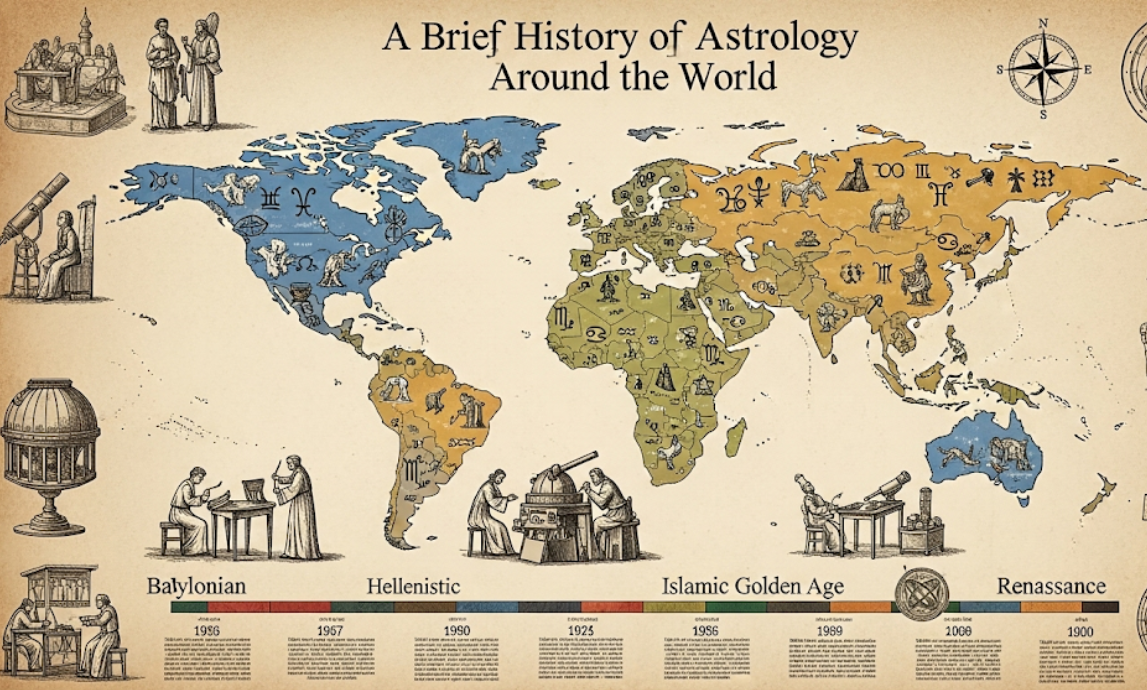
Regional Uniqueness: Astrology All Over The Globe
African Astrology
African tribes have had their own astrological studies, typically as a result of ancestral worship and nature-based beliefs. Such systems usually concern community resilience, not personal divination.
Native American Star Knowledge
The Americas were home to advanced astrological and astronomy systems established by Indigenous peoples. Star patterns were important to many tribes for navigation, agricultural timing and spiritual ceremonies.
Celtic and Nordic Traditions
Northern European cultures made their own astrological systems, with cycles based on cosmic movements and seasonal astronomical events.
Digital Age: Astrology Goes Online
Internet Revolution
The internet changed the game as far as how people received and interacted with astrology. This information was then spread to billions of people all around the globe through websites, applications and social networks.
Digital astrology innovations:
- Automated birth chart calculations
- Daily horoscope apps
- Online astrological communities
- Video consultations with astrologers
- AI-powered astrological interpretations
Social Media Influence
Instagram, TikTok and Twitter have spawned a generation of astrology influencers, drawing millions of followers with astrological content on a daily basis.
Popular social media astrology trends:
- Meme-based astrological content
- Live astrological readings
- Astrological compatibility tests
- Mercury retrograde awareness
- Full moon & new moon rituals
Scientific Perspective and Criticism
The Skeptical View
Modern science does not recognize astrology as a valid prediction mechanism. Despite centuries of interest in the planets’ alignment and how it affects our daily lives — think horoscopes, zodiac signs or Mercury retrograde — scientific studies have consistently failed to support beliefs about astrology related to personality and behavior.
Common scientific criticisms:
- Lack of empirical evidence
- Star positions are affected by precession of the equinoxes
- Gravity isn’t strong enough to have a measurable impact on human behavior
- No significantly better than random predictions from statistical tests
- Interpreted through observer bias and confirmation bias
Cultural and Psychological Value
Still, to many, astrology is valuable for self-reflection, cultural ties, and insights. Some psychologists believe astrology can serve as a mirror for self-examination.
Current Global Landscape
Astrology by the Numbers
The astrology industry is a multi-billion dollar industry worldwide today. Several surveys now indicate that the appeal of astrology has been on the rise with younger generations.
Modern astrology statistics:
- More than 50% of Millennials are interested in astrology
- Multi-million dollar astrology app market
- Daily horoscopes in newspapers are read by millions of people
- Professional astrologers in every big city
- Billions of online views on astrology content
Regional Popularity
Some regions show more astrological interest than others:
High-interest regions:
- United States and Canada
- India and Southeast Asia
- South America
- Eastern Europe
- Australia and New Zealand
Lower-interest regions:
- Northern Europe
- East Asia (exception: traditional Chinese astrology)
- Parts of the Middle East
- Sub-Saharan Africa
Future of Astrology
Emerging Trends
Several trends are moving astrology into the future:
- Use of Technology: Astrology Augmented Reality Experiences
- Personalization: AI-customized astrological readings
- Cross Cultural Integration: Combining astrological traditions from different countries
- Dialogue with Science: More sophisticated conversation between astrologers and scientists
- Therapeutic Applications: Astrology in counseling and self-help
Challenges and Opportunities
As astrology modernizes in the digital age, there are challenges and opportunities emerging. Its validity is challenged by critics and supported as a matter of culture and personal belief.
Conclusion: Astrology’s Enduring Appeal
From the astrology of ancient Babylonian star-watchers to astrological apps on your smartphone, astrology is one of the few belief systems that have held sway over people of different cultures for thousands of years. Whether considered a sacred belief system or simply a guide to self-understanding and life planning, astrology continues to impact how people perceive themselves, others, and their place in the world.
Astrology’s history shows a perpetual human need to discover meaning and regularity within the firmament. While our capacity to measure and understand the sky has improved a great deal, we still have questions that astrology can help us explore. As humans continue exploring space and creating new technologies, astrology too is updated and adapted to remain relevant in the changing world.
Today’s global astrology represents a unique blending of modern innovation with ancient wisdom. Some people share astrological memes on social media while others spend lifetimes studying thousand-year-old texts. Mobile apps can calculate birth charts within seconds; ancient astrologers had to draw out complex diagrams by hand.
This long history proves that whether anyone believes astrology works or not, humanity has been inspired by it for thousands of years. From the ziggurats of ancient Mesopotamia to the smartphones in our pockets, we are still held spellbound by the stars — they enthrall us, inspire us, and provide us with a sense of connection beyond ourselves.
In the grand scheme of astrology, these developments are significant only insofar as they communicate some truth about the universe and about what humans have believed over many thousands of years. Astrology enters the 21st century carrying centuries of human fascination, cultural knowledge, and an undying urge to understand our place in the cosmic order.


