


Ever wondered why your horoscope can read differently if you tune in to a different source? It depends on whether you are looking at Western astrology or Vedic Astrology. These two illustrious cosmologies have captivated the human race for aeons, but they approach those most sparkling flames through different methods.
Whether it be Western or Vedic, both styles are designed to help people have a better sense of who they are and what their place is in the world. Nevertheless, they do this by way of different methods, calendars, as well as types of understanding. In this ultimate guide, we are sharing the main things that set these two commonly used astrological systems apart along with suggestions for which may be more in alignment with your unique path.
The History Behind: Where the Systems Were Born
Western Astrology’s Greek Origins
Western astrology began to be practiced in ancient Greece, around the 2nd century BCE. This model was a product of development by Greek astronomers and philosophers such as Ptolemy using Babylonian astronomical knowledge with Greek mathematical prowess. The zodiac wheel we are familiar with today was invented by the Greeks and consists of twelve parts, 30 degrees per division.
This system was further developed during the time of the Roman Empire and spread throughout Arabia during that period. This caused Western astrologers to stray away from the realm of pure predictive astrology and move towards interpreting astrology as a psychological process, which was defined during the Renaissance.
Vedic Astrology’s Ancient Indian Heritage
Vedic astrology, more commonly known as Jyotisha, has even earlier origins. Originating in India more than 5,000 years ago, it is intrinsically intertwined with the Vedas—ancient Sanskrit texts that form the basis of Hindu teaching. The term Jyotisha means “the science of heavenly bodies” or more generally, “light” that denotes all spiritual enlightenment.
Clearly, in a way Western astrology did not experience, Vedic astrology was able to retain its religious and spiritual roots. The Indian sages had created the system not only to ascertain specific personal codes but also as a tool for transcending spiritual realizations and karma resolutions.
Fixed vs. Moving Stars in The Zodiac Systems
The Tropical Zodiac (Western Approach)
Western astrology is reliant upon the tropical zodiac, which tracks Earth’s relation to the Sun rather than actually tracking stars. This system:
- Begins with the Vernal Equinox (0 degrees Aries)
- Breaks the entire year into 12 equal, thirty-degree parts
- Stays in place despite the motion of stars over time
- Studies broader seasonal shifts and their psychological effects
Example: If you were born on March 21st, then irrespective of where the constellation Aries occurs in the sky, Western astrology will always treat you as an Aries.
The Sidereal Zodiac (Vedic Approach)
Vedic astrologers use a zodiac known as the sidereal zodiac, which is based on the actual positions of constellations in space. This system:
- Takes into consideration the precession of equinoxes (wobble of Earth)
- Corrects for slow shift of stars over centuries
- Currently lags approximately 24 degrees behind tropical zodiac
- Provides astronomically accurate star positions
So, for instance, a person who was born on March 21 will still be counted as a Pisces in Vedic astrology since the actual zodiac constellation of Aries hasn’t reached that position yet.
Your Sun Sign: Why It Is Often Different
It is this foundational difference in the zodiac system that explains why your sun sign may vary between Western and Vedic astrology.
Comparison Table for Typical Date Ranges
| Sun Sign | Western Astrology Dates | Vedic Astrology Dates (Approx.) |
|---|---|---|
| Aries | March 21 – April 19 | April 13 – May 14 |
| Taurus | April 20 – May 20 | May 15 – June 14 |
| Gemini | May 21 – June 20 | June 15 – July 14 |
| Cancer | June 21 – July 22 | July 15 – August 14 |
| Leo | July 23 – August 22 | August 15 – September 15 |
| Virgo | August 23 – September 22 | September 16 – October 15 |
| Libra | September 23 – October 22 | October 16 – November 14 |
| Scorpio | October 23 – November 21 | November 15 — December 14 |
| Sagittarius | November 22 — December 21 | December 15 — January 13 |
| Capricorn | December 22 – January 19 | January 14 – February 11 |
| Aquarius | January 20 – February 18 | February 12 – March 12 |
| Pisces | February 19 – March 20 | March 13 – April 12 |
House Division Systems
Western House Systems
Most popular house systems in Western astrology:
- Placidus — relies on time calculations
- Equal House System — divides the chart into twelve equal partitions of 30 degrees each
- Whole Sign Houses — where each sign becomes one whole house
- Koch System — based on latitude of birth
The Placidus system is the most popular; every Western astrologer probably has used or uses it, and Placidus houses are of unequal size according to the time you were born.
Vedic House Systems
The house system of Vedic astrology mainly uses two types:
- Whole Signs – Aries is 1st, Taurus is 2nd, etc.
- Equal House System – 30-degree houses from the ascendant
The whole sign house system is simpler and does not need exact birth times, increasing its accessibility.
Planets and Their Roles
Western Planetary Focus
Western astrology focuses on ten primary heavenly bodies:
Personal Planets:
- Sun (ego and identity)
- Moon (emotions and instincts)
- Mercury (communication and thinking)
- Venus (love and beauty)
- Mars (action and desire)
Social Planets:
- Jupiter (growth and wisdom)
- Saturn (discipline and structure)
Outer Planets:
- Uranus (innovation and rebellion)
- Neptune (dreams and spirituality)
- Pluto (transformation and power)
Vedic Planetary System
Vedic Astrology is based on considering nine planets which are termed as Navagraha:
Visible Planets:
- Sun (Surya) – soul and father
- Moon (Chandra) – mind and mother
- Mars (Mangal) – brother and energy
- Mercury (Budh) – intelligence and communication
- Jupiter (Guru) – knowledge and teacher
- Venus (Shukra) – luxury and relationships
- Saturn (Shani) – karma and obstacles
Shadow Planets:
- Rahu (North Node) – desires and obsessions
- Ketu (South Node) – spirituality and detachment
Uranus, Neptune, and Pluto are not used in traditional Vedic astrology; instead, the lunar nodes (Rahu and Ketu) are of major importance.
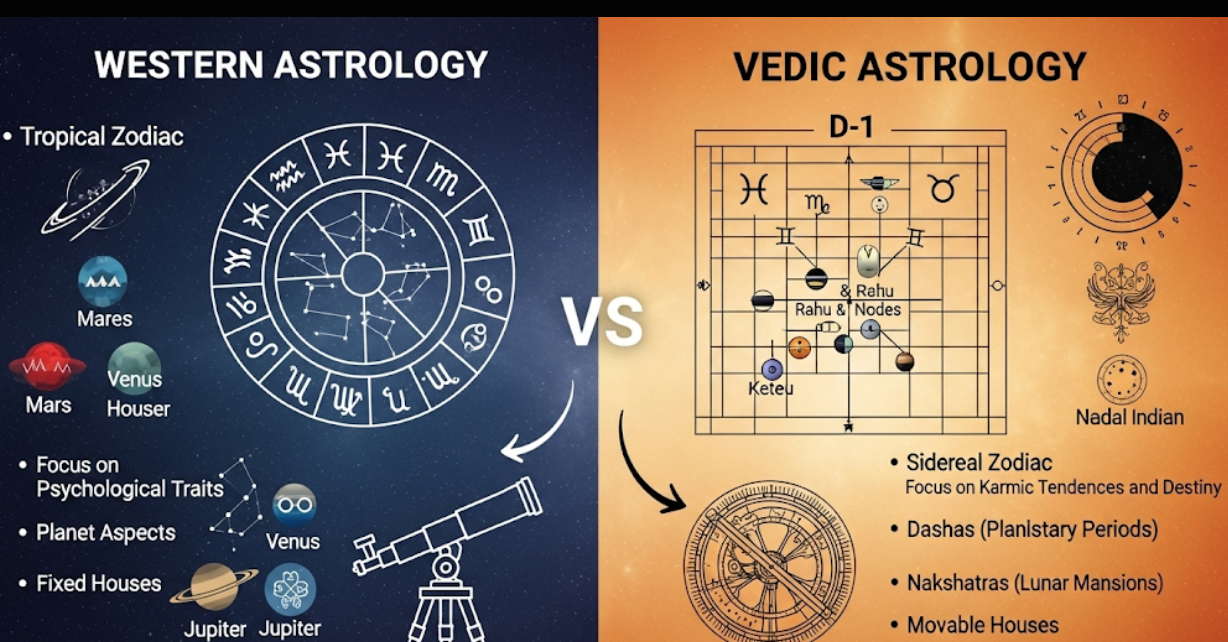
Prediction Methods: Psychology vs. Karma
Western Astrology’s Psychological Approach
Modern Western astrology uses a psychological interpretation approach:
- Focuses on personality traits and behavior patterns
- Emphasizes free will and personal agency
- Uses timing via transits and progressions
- Views astrology as a form of self-knowledge
- Less focused on specific event predictions
Common Western Techniques:
- Natal chart interpretation
- Transit analysis
- Solar returns
- Composite charts for relationships
- Progressions for personal development
Vedic Astrology’s Karmic Framework
Vedic astrology operates within a karma-based belief system:
- Attributes life events to past karma
- Emphasizes dharma and karma
- Provides specific timing for events
- Offers remedial paths through rituals and gemstones
- Combines spiritual development with material success
Common Vedic Techniques:
- Dasha systems (planetary periods)
- Transit analysis with natal chart
- Divisional charts (Vargas) for specific life areas
- Muhurta (electional astrology)
- Compatibility matching for marriage
Chart Reading Styles
Western Chart Interpretation
Western astrologers typically focus on:
- Aspect patterns between planets
- Element balance (fire, earth, air, and water)
- Modality emphasis (cardinal, fixed, mutable)
- Hemisphere emphasis
- Chart shapes and configurations
This reading style tends to be more subtle and interpretive.
Vedic Chart Analysis
Vedic astrologers examine:
- Planetary strength (Shadbala)
- Yogas (planetary combinations)
- House lords and their positions
- Divisional chart analysis
- Dasha periods and sub-periods
This system provides more concrete and specific predictions.
Remedial Measures: Different Solutions
Western Astrology Solutions
Western astrology typically suggests:
- Awareness and consciousness-raising
- Therapy and counseling
- Timing favorable periods for action
- Working with planetary energies psychologically
- Crystals (in certain modern contexts)
Vedic Astrology Remedies
Vedic astrology offers concrete remedial measures for various problems:
Gemstone Therapy:
- Ruby for Sun
- Pearl for Moon
- Red coral for Mars
- Emerald for Mercury
- Yellow sapphire for Jupiter
- Diamond for Venus
- Blue sapphire for Saturn
Ritual Practices:
- Mantras for specific planets
- Yantras (geometric diagrams)
- Fasting on specific days
- Charity and donations
- Temple visits and prayers
Lifestyle Adjustments:
- Color therapy
- Direction preferences
- Astrological career counseling
- Marriage timing and compatibility
Accuracy and Precision
Timing Predictions
Western Astrology:
- Better for psychological insights
- Effective for understanding personality patterns
- Useful for relationship dynamics
- Less precise for event timing
Vedic Astrology:
- More accurate for event timing
- Good for career and marriage predictions
- Useful for health and financial predictions
- Stronger emphasis on life purpose
Birth Time Requirements
Western Astrology:
- Needs exact birth time for house positions
- Can work with rough times for basic readings
- Rectification methods for unknown birth times
Vedic Astrology:
- Essential for accurate predictions
- Whole sign houses reduce birth time sensitivity
- Strong rectification techniques available
- Provides insights even with approximate time
Choosing Your Astrological Path
When to Choose Western Astrology
Western astrology is for you if you:
- Prefer psychological and therapeutic approaches
- Focus on personal development and self-awareness
- Enjoy exploring relationship dynamics
- Are comfortable with flexible interpretations
- Don’t believe in karma or reincarnation
When to Choose Vedic Astrology
Vedic astrology might speak more to your soul if you:
- Believe in karma and dharma
- Desire specific timing of life events
- Prefer structured and traditional approaches
- Are interested in spiritual growth
- Want concrete remedial measures
- Have Indian cultural background
Modern Applications and Technology
Digital Age Adaptations
Each system has adapted to modern technology:
Western Astrology:
- Popular apps such as Co-Star and The Pattern
- Social media astrology content
- Online birth chart generators
- Psychological astrology courses
Vedic Astrology:
- Sophisticated software for calculations
- Online Kundali matching services
- Digital gemstone recommendations
- Virtual consultation platforms
The Scientific Debate
Research and Validation
Scientific studies have found no evidence supporting astrological claims, and scientists almost universally consider astrology to be pseudoscience. However:
Western Astrology:
- Some psychological correlates have been found in research
- Some effects are explained by the Barnum Effect
- Provides good symbolic language for self-reflection
Vedic Astrology:
- Statistical studies show mixed results
- Thousands of years of cultural validation
- Integrated with Ayurveda and other Indian sciences
Combining Both Systems
Integrative Approaches
Many modern practitioners combine elements of both systems:
- Psychological insights from Western astrology
- Timing techniques from Vedic astrology
- Remedial measures from both traditions
- Cultural sensitivity in application
This blending of two traditions creates an opportunity for practitioners to benefit from the strengths of both, remaining true to their roots while being sensitive to the demands of the modern world.
Conclusion: Your Cosmic Journey Continues
Western and Vedic astrology differ because of their distinct cultural roots and philosophical underpinnings. Western astrology provides psychological analysis and individual empowerment, whereas Vedic astrology delivers precise timing and spiritual guidance within a karmic framework.
You don’t have to choose between these systems. Many people find balance using both systems—Western astrology for personality insights and Vedic astrology for life timing and spiritual teachings. The main thing is that you find a system that aligns with your beliefs, culture, and ultimate goals.
Whether you are drawn to the transformative and seasonal wisdom of the tropical zodiac, or to the stellar accuracy of the sidereal zodiac that shows where constellations actually are when viewing them from Earth, both paths have tools that can help guide your way into deeper self-discovery. Your astrological journey is uniquely yours, and the stars are not judgmental.
As always, astrology functions best as a tool of self-reflection and guidance rather than absolute fortune-telling. Use these ancient systems to understand your potential, timing, and spirituality, but remember you still have the ability to choose and act consciously while navigating important phases in life.
The universe is vast, and both Western and Vedic astrology offer different windows through which we can view it. Pick your perspective and let the stars guide you on a path to greater self-discovery and meaning.


