


Astrology has long captured the human imagination for thousands of years now, and it is not surprising at all that it is one of the most misunderstood subjects ever to appear in modern times. Many of us hold beliefs about astrology that are simply wrong, from the most casual horoscope reader to the most hardcore expert. So whether you’re astrology-curious or totally zodiac-skeptic, this guide is here to help you zero in on the truth.
Here are some of the biggest falsehoods about astrology, and a deeper look at what this centuries-old practice is really all about.
Why Your Morning Reading Isn’t Real Astrology: The Daily Horoscope Trap
Horoscopes Are General Entertainment, Not Private Prediction
It is thinking that daily horoscopes appearing in either newspapers or apps are doing real astrology. They are little predictions written for millions of people with the same sun sign, making them about as personal as a takeout fortune cookie.
Real astrology considers:
- Birth time down to the minute
- City + Country where you were born
- Your complete birth date
- The planets themselves — all of them, not only the sun
- Your chart broken down into twelve houses
- Planetary aspects and angles
The Math Behind Personal Charts
Both of these require complex calculations to be made whereby different aspects will interact with one another as it lays out an individual’s astrological chart.
| Element | Description |
|---|---|
| Birth Time | Determines house positions and rising sign |
| Birth Location | Affects planetary positions due to Earth’s rotation |
| Planetary Positions | Where each planet was on your natal chart |
| House System | How the sky is divided into twelve sections |
That is why when you look at a generic horoscope that doesn’t take that into account, it always will be inaccurate to your situation.
The Single Sign Myth — You Are More Than Just Your Sun Sign
A Recipe of Your Astrological Makeup
Astrology is not equivalent to a single zodiac sign, but having one sign might be like calling a cake complete with only flour. There are several components within your astrological profile that all work in concert:
The Big Three:
- Sun Sign – It represents the personality and ego
- Moon Sign – It tells you about your emotions and inner world
- Rising Sign – What you look like to the outside world, and how you project into life
Other Important Placements:
- Mercury sign (communication style)
- Venus sign (love and relationships)
- Mars sign (energy and motivation)
- Jupiter sign (growth and opportunities)
- Saturn sign (challenges and lessons)
Why This Matters for Accuracy
As in — “But, I’m a Gemini and I am not chatty,” — their Mercury may be in Cancer (communication through emotions) or their rising sign might be Scorpio (the appearance of mystery). Only when seen together do these findings reconcile the seeming contradictions.
Astrology: A Psychological Tool Not a Fortune Teller
Astrology Doesn’t Predict Specific Events
Astrology is not here to tell you that you are going to meet your soulmate next Tuesday or maybe you will win the lottery on Friday. This misconception comes from:
- Hollywood portrayals of fortune tellers
- Misrepresentation in media
- Confusion with psychic readings
- Oversimplified horoscope predictions
What Astrology Actually Offers
Instead, astrology provides:
- Insights into personality patterns
- Timing for personal growth
- Relationship compatibility factors
- Career and life path guidance
- Emotional and psychological awareness
Similar to a weather forecast inside rather than a crystal ball predicting particular future events.
The Science Debate: Answering the Research Question
When Scientific Studies Fail to Connect The Dots
For example, many critics have cited research that debunks astrology — there is some out there to be sure — but much of it tests the wrong things.
Common Study Flaws:
- Testing only sun sign divination (not full charts)
- Comparing with generic personality tests vs astrological methods
- Expecting specific event predictions
- Failing to adjust for the quality of the astrologer
- Not understanding the purpose of astrology
The Real Research Challenge
Studying astrology properly would require:
- Accurate birth data of all the participants
- Complete astrological chart analysis
- Qualified astrologers conducting readings
- Psychological insights methodologically tested
- Studies conducted over several years indicating possible time trends
The conclusions of a great majority of astrological studies are therefore strongly disputable from the vantage point of empirical science.
Compatibility Confusion: Sun Signs Aren’t Everything
The Oversimplified Relationship Guide
Sun sign compatibility makes us miss some connections and starts relationship drama for the sake of it.
Sun Sign Compatibility Is Only Part of the Picture
- Venus signs – How you love
- Mars signs – Attraction and conflict styles
- Moon signs – Emotional compatibility
- Mercury signs – Communication patterns
- Rising signs – First impressions
Real Compatibility Factors
A complete relationship analysis considers:
| Factor | What It Reveals |
|---|---|
| Venus Signs | Love languages and romantic needs |
| Mars Signs | Sexual compatibility and conflict resolution |
| Moon Signs | Emotional connection and nurturing styles |
| Mercury Signs | Communication patterns, intellectual connection |
| Composite Charts | The unique energy of the relationship itself |
For example, two people with conventional Leo sun signs can be perfectly compatible with regards to their Venus and Mars placements.
The Personality Stereotype Problem
Breaking Free from Zodiac Boxes
All zodiac signs are framed as simple stereotypes:
- Geminis are two-faced
- Scorpios are jealous and vengeful
- Virgos are nitpicky perfectionists
- Sagittarians are commitment-phobic
These reductive ideas leave out a lot of the layers of human personality and the nuance found in actual astrological charts.
The Reality of Sign Expression
Every sign has:
- Well-developed positive traits
- Shadow traits which come out under stress
- Growth and change potential in evolution
- Varied expressions from other chart influences
This can show up for example with Scorpio’s intensity as:
- Deep emotional healing abilities
- Passionate dedication to causes
- Powerful transformation and resilience
- Investigative and research skills
The shadow side is all the stereotype takes in.
Timing Misconceptions: When Astrology Applies
The Stars Are More Than Just Your Birth Chart
Most people only regard astrology when they look to their birth chart, overlooking the powerful timing components.
Current Sky Influences:
- Daily planetary movements
- Monthly lunar cycles
- Yearly solar returns
- Major planetary transits
Personal Timing Methods:
- Progressions (internal psychological development)
- Annual and monthly themes (solar/lunar returns)
- Transit analysis (external factors and environmental strengths)
How Timing Actually Works
Astrological timing identifies the best time for:
- Starting new projects
- Making important decisions
- Relationship milestones
- Career changes
- Personal growth work
It does not ensure winning but tells when the efforts will be naturally supported.
Free Will vs. Determinism: You Make Your Choice
Astrology Doesn’t Control Your Life
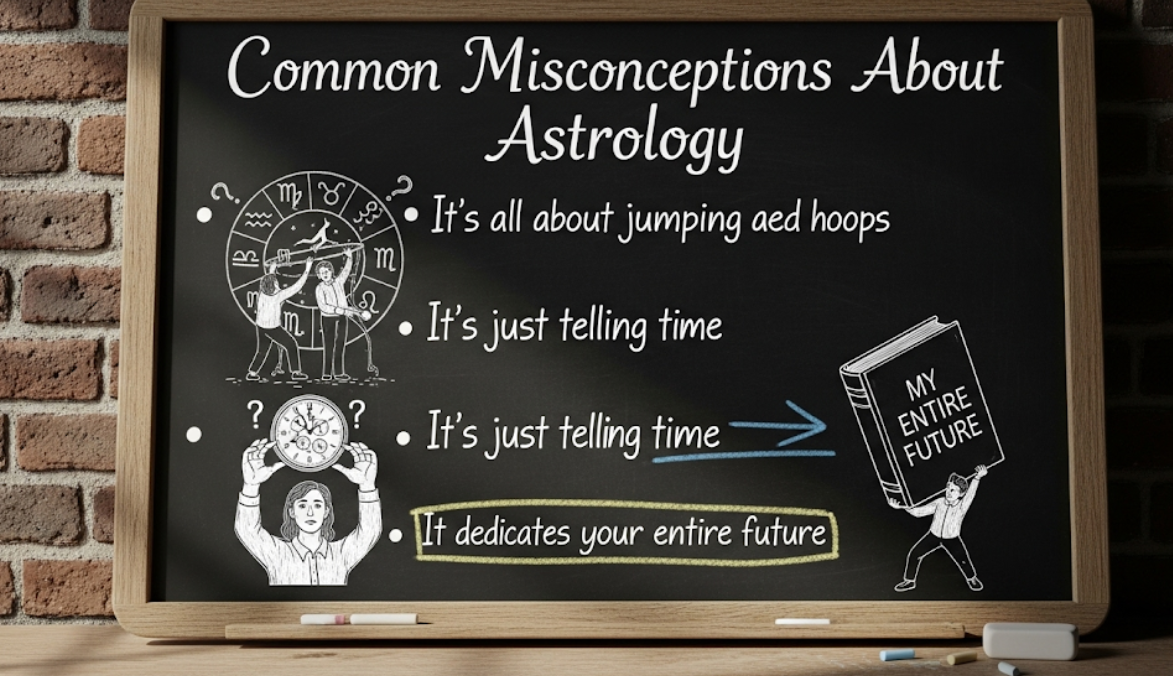
There are a lot of misunderstandings about astrology leading people to believe that if you put faith in it, then your life is pre-destined. This is a fatalistic view, and the truth of astrology exists as an instrument for making conscious decisions.
What Astrology Suggests:
- Potential energy patterns
- Likely challenges and opportunities
- Natural timing cycles
- Personality tendencies
What You Control:
- How you respond to challenges
- Which opportunities you pursue
- Your personal growth and development
- Your relationship choices and behaviors
The Co-Creation Model
Modern astrology speaks to the merging of cosmic timing with individual will — in short, partnership:
- The stars suggest; you decide
- Challenges become growth opportunities
- The most difficult transits lead to some of the biggest breakthroughs
- How energies manifest is based on your consciousness level
Professional Astrology vs. Pop Culture
The Skill and Training Factor
Not all astrology is created equal. There is about as much in common between what a trained astrologer does and someone who reads generic horoscopes.
Professional Astrologers Study:
- Chart calculation and interpretation
- Psychological counseling techniques
- Mythology and symbol systems
- Timing methods and forecasting
- Ethics and client care
- Ongoing education and certification
What Good Astrology Readings Should Deliver
A skilled astrologer provides:
- Detailed chart analysis
- Practical life guidance
- Timing for important decisions
- Relationship and career insights
- Personal growth direction
- Respectful, non-judgmental consultation
The Cultural and Historical Context
Astrology’s Rich Global Heritage
The twelve-sign system most people know is western astrology, one of many traditions:
Major Astrological Systems:
- Vedic (Hindu) astrology from India
- Chinese astrology with animal years
- Mayan astrological calendars
- Celtic tree astrology
- Native American animal totems
Each system was developed in a particular cultural context and, as such, offers different sorts of insight.
Evolution of Modern Practice
Modern astrology has moved beyond ancient fortune telling:
- Psychological Astrology – Concentrates on personal growth
- Evolutionary astrology – Emphasizes soul growth
- Medical astrology – Examines health patterns
- Mundane astrology – Studies world events
- Financial astrology – Analyzes market trends
Getting Started: Approaching Astrology Wisely
Tips for Exploring Astrology
If you want to get your feet wet in astrology, here’s where you should start:
- Get the whole picture of your birth chart from a reputable source
- Know all of your placements, not just your sun sign
- Hire professional astrologers for readings
- Practice fundamentals before a deep dive in advanced skills
- Stay skeptical while open-minded
- See it as self-reflection and not life control
Red Flags to Avoid
Be wary of:
- Astrologers making specific predictions
- People who say astrology can promise results
- Fear- or dependence-based readings
- Costly “solutions” or products for sale
- Unskilled or unqualified astrologers
Resources for Learning
Recommended Starting Points:
- Professional astrology organizations
- Accredited astrology schools
- Reputable books by established astrologers
- Quality online courses with trained instructors
- Local astrology groups and meetups
Your Journey with the Stars
When understood and used correctly, astrology can be an incredibly useful tool for examining personality, relationships, and life timing. However, once you get past these common misconceptions, you can see its importance as a self-awareness and development tool.
When it comes to astrology, remember:
- Critical thinking and personal judgment
- Psychological insight and emotional intelligence
- Practical action and real-world experience
- Ongoing learning and open-mindedness
- Appreciation for boundaries and use cases
Whether you become a lifelong student or dabble with sun signs, maintaining an insightful approach to the practical fields of astrology is far more valuable than falling for common misconceptions. While your stars might not determine your future, they can help guide you on the road to greater self-realization and varied being.
So the next time someone rolls their eyes at astrology due to horoscope misconceptions or preconceived ideas about zodiac signs, you know there is a lot more depth to dive into! Anything complex, like astrology for example, rewards those who take time to learn the real nature of it as opposed to settling for more simplified forms.
So astrology can be your friend, but it doesn’t have to be. Take advantage of this information to ensure that your choice is an educated one, not based on the myths that hold back so much of the public’s perception of this millennia-old and evolving field.


