


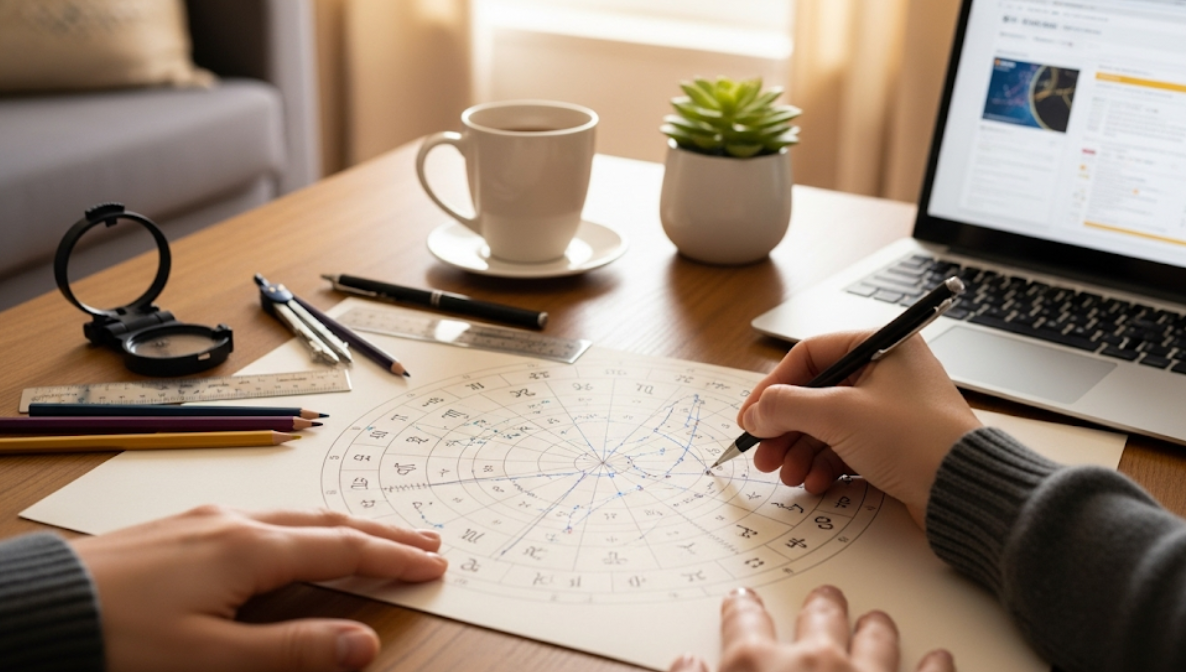
Ever wondered what the stars were doing when you took your first breath? You can also practice making your astrology chart right at home using some very basic techniques and you do not need to buy fancy software or take any assistance from a professional helper. And in less than about 30 minutes and using these totally free tools you can uncover the cosmic mysteries within your astrological birth chart.
The Picture of Your Stars at Birth
Your astrology chart, often referred to as your natal chart or birth chart, is like a photo of the sky at exactly the moment and place you were born. It is a kind of special cosmic fingerprint — no two charts are the same, even for twins born moments apart. This celestial map can reveal insights about your character, relations, professional life and journey.
Personality Traits in Your Birth Chart
Beyond just your sun sign (the zodiac sign that most people know), your birth chart is a comprehensive look at the planets’ placements when you were born. Your sun sign is your core personality, but a full chart also adds:
- Moon sign: Your instinctual reactions, emotional nature, and inner world
- Ascendant (Rising sign): How others see you and your first impression
- Planet locations: Mercury, Venus, Mars, Jupiter, Saturn, Uranus, Neptune, Pluto
- Houses: Twelve life areas corresponding to where planetary energies are expressed
- Aspects: A degree of harmony or friction between two planets
Gathering Your Birth Information
You need three key pieces of information in order to create your chart:
Birth Date
This one is fairly straightforward: do not forget the year! In some systems, being off by one day can shift planetary locations.
Exact Birth Time
This is the main data from which an authentic chart can be made. Your birth time affects:
- The Sign that was Rising on the Horizon at the Time of Your Birth (Changes Every 2 Hours)
- House positions of all planets
- Moon sign changes (for people born with the moon changing signs)
Where to Find Birth Times:
- Birth certificate (most reliable source)
- Hospital records
- Baby book or family records
- Ask other family members who were there
What if you do not know your exact time? If you are unable to locate your exact birth time, a chart can still be created using noon as an approximate time. This is not a substitute for your house positions and rising sign, but the planets are going to be in most of the right places.
Birth Location
This is the city, state/province, and country you were born in. This will influence the calculations used to determine your chart, so try to be as specific with the latitude and longitude coordinates as possible.
Free Online Charting Tools
Many websites offer free calculations of a birth chart. Here are the top options:
Astro.com (Extended Chart Selection)
Pros:
- Most comprehensive free charts available
- Professional-quality calculations
- Multiple chart styles and options
- Detailed interpretations
How to use:
- Go to astro.com
- Tap “Free Horoscopes” and then “Extended Chart Selection”
- Enter your birth data
- Select Natal Chart Wheel for Chart Picture
Cafe Astrology
Pros:
- User-friendly interface
- Good for beginners
- Includes basic interpretations
- Fast and simple
Astrolabe Free Charts
Pros:
- Clean, easy-to-read charts
- No registration required
- Quick results
TimePassages (Basic Version)
Pros:
- Beautiful chart designs
- Includes some interpretation
- Mobile-friendly
Step-by-Step Chart Creation Process
In this post, I’ll guide you on creating your own chart with Astro.com as an example:
Step 1: Go to the Chart Tool
- Visit astro.com
- Click “Free Horoscopes” from the main menu
- Select “Extended Chart Selection”
- You will see a form that asks for your birth info
Step 2: Enter Your Birth Data
Fill in the required fields:
- Name: Put in your first name (or leave it blank); simply for tagging
- Birth date: Choose the month, date, and year you were born on
- Time: Your birth time (24-hour format)
- Location: Type in your place of birth, then select from the dropdown options
Step 3: Select Chart Type
- Opt for “Natal Chart Wheel” if you prefer the classic circular chart
- You may select another house system (Placidus is the default)
- Click “Click here to show the chart”
Step 4: Download or Print Your Chart
Once your chart appears:
- Screenshot for your records
- Print it out using the print function
- Save the bookmark if you want to come back to this page
DIY Astrology Chart Reading
Your final chart will be a circle divided into 12 sections (houses) with symbols all over. Here’s how to decode it:
The Zodiac Signs
The 12 zodiac signs circle the outer wheel in your birth chart:
| Zodiac Sign | Symbol | Element | Quality |
|---|---|---|---|
| Aries | ♈ | Fire | Cardinal |
| Taurus | ♉ | Earth | Fixed |
| Gemini | ♊ | Air | Mutable |
| Cancer | ♋ | Water | Cardinal |
| Leo | ♌ | Fire | Fixed |
| Virgo | ♍ | Earth | Mutable |
| Libra | ♎ | Air | Cardinal |
| Scorpio | ♏ | Water | Fixed |
| Sagittarius | ♐ | Fire | Mutable |
| Capricorn | ♑ | Earth | Cardinal |
| Aquarius | ♒ | Air | Fixed |
| Pisces | ♓ | Water | Mutable |
Planet Symbols and Meanings
Personal Planets (change signs frequently):
- Sun ☉: Inner identity, ego, life purpose
- Moon ☽: Emotion, instincts, subconscious needs
- Mercury ☿: Communication, mental processing, learning mode
- Venus ♀: Affection, beauty, values, money
- Mars ♂: Action, desire, quest for goals
Social Planets (change signs every 1-2 years):
- Jupiter ♃: Growth, luck, philosophy and higher learning
- Saturn ♄: Discipline, responsibility, life lessons
Outer Planets (7-20+ years to change signs):
- Uranus ♅: Innovation, rebellion, sudden upheaval
- Neptune ♆: Dreams, spirituality, illusion, creativity
- Pluto ♇: Transformation, power, deep psychological change
The 12 Houses Explained
The houses are where the planetary energies manifest in various aspects of life.
Personal Houses (1-4):
- House 1: Ego, body, first impressions
- House 2: Money and possessions, self worth
- House 3: Communication, siblings, short trips, learning
- House 4: Home, family, roots and emotional foundation
Social Houses (5-8): 5. House 5: Creativity, romance, children, leisure, self-expression 6. House 6: Work, health, daily routines, service 7. House 7: Partnerships, marriage, open enemies 8. House 8: Other people’s money, sex, death, the occult
Universal Houses (9-12): 9. House 9: Higher education, philosophy, travel, religion 10. House 10: Career, reputation, authority and how you inspire the public 11. House 11: Friends, groups, hopes, dreams, social causes 12. House 12: Spirituality, self-undoing and solitude
Interpreting Your Chart’s Key Components
Your Big Three
First, identify your top three placements:
- Sun Sign: Find the ☉ symbol. This is your essence, what you came here to experience
- Moon Sign: Find the ☽ symbol. This tells a story about your emotional self and what you need to feel safe and nourished
- Rising Sign: The zodiac sign on the left side of your chart (9 o’clock position). It is how you appear to the public and how you deal with new things
Planetary Concentrations
Check to see if you have several planets in one sign or house. Putting an emphasis in that area of life creates a level where you can accomplish and thereby grow stronger.
- Stellium: 3 or more planets in the same sign or house
- Note: If some houses have NO planets, don’t worry, this is totally normal
Look at the number of planets you have in fire, earth, air and water signs.
Aspects Between Planets
An aspect is the angle between planets, responsible for unique types of energy generated by their influences.
Easy Aspects (Harmonious Energy):
- Trine (120°): Natural abilities and ease of energy flow
- Sextile (60°): Opportunities and cooperative effort
Challenging Aspects (Dynamic Energy):
- Square (90°): Tension that drives growth and action
- Opposition (180°): Pressure for balance between extremes
Neutral Aspects:
- Conjunction (0°): Planets blend their energies
Creating Your Own Chart Interpretation
Step 1: Start With Your Big Three
Note down your Sun, Moon and Ascendant signs. Look up what every placement is associated with as far as your personality goes.
Example interpretation framework:
- “My Sun in [Sign] means I…”
- “My Moon in [Sign] means I need emotionally…”
- “My Rising in [Sign] means others see me as…”
Step 2: Examine Planet-House Pairs
Notice in what house each planet falls, and combine the meanings.
Examples:
- Venus in the 7th House: Seeks harmony in partnership
- Mars in 10th House: Working ambitiously in career
- Jupiter in the 3rd House: Optimistic communicator, life-long student
Step 3: Note Any Patterns
Look for repeating themes:
- Many planets in earth signs? You are likely practical and grounded
- Many planets in water signs? You are most likely a very intuitive and emotional person
- Concentration in the 10th House? You care a lot about your career and public image
Chart Interpretation Worksheets and Templates
Create your own chart decoder by completing these worksheets:
Personal Planet Summary
- Sun Sign: _________ House: _________ Meaning: __________
- Moon Sign: _________ House: _________ Meaning: __________
- Mercury Sign: _________ House: _________ Meaning: __________
- Venus Sign: _________ House: _________ Meaning: __________
- Mars Sign: _________ House: _________ Meaning: __________
Element Balance Check
Number of your planets in each element:
- Fire Signs (Aries, Leo, Sagittarius): ___ planets
- Earth Signs (Taurus, Virgo, Capricorn): ___ planets
- Air Signs (Gemini, Libra, Aquarius): ___ planets
- Water Signs (Cancer, Scorpio, Pisces): ___ planets
Primary Element: _________ Personality Meaning: __________
Common Beginner Mistakes to Avoid
Mistake 1: Only Focusing on the Sun Sign
Your sun sign is just one part of your cosmic cocktail. Pay just as much consideration to your moon sign and your rising sign in order to fully round out the picture.
Mistake 2: Fearing “Bad” Aspects
There are no absolutes in astrology. Difficult aspects like squares and oppositions create friction and thus serve as dynamic forces pushing forth growth and achievement.
Mistake 3: Expecting Instant Expertise
Learning astrology takes time. You will build upon that understanding with increasingly sophisticated concepts as you grow more comfortable with reading charts.
Mistake 4: Incorrect Time of Birth
If you are unsure of your precise time of birth, be honest that this is a limitation. Your interpretation of the chart will be thrown off if you have an incorrect time.
Mistake 5: Being Too Literal About Everything
Astrology operates as a symbolic language and as a tool for self reflection. Use your chart insights to better understand yourself, not as absolute predictions of the future.
Advanced DIY Techniques
After you have gained a good understanding of the basics in reading charts, try these advanced techniques:
Progressions and Transits
- Progressions: Changes your chart undergoes with time
- Transits: Current planets affecting your natal chart
Use astro.com’s more advanced functionality to further investigate these timing strategies.
Compatibility Charts (Synastry)
Compare charts with your friends, family or lovers:
- Create charts for both people
- Look for compatible sun/moon/rising signs
- See how one person’s planets interact with the other’s houses
Return Charts
Charts that are cast specifically for the return of planets to their positions at birth:
- Solar Return: Your chart every year on your birthday
- Lunar Return: Monthly emotional cycles
- Saturn Return: Major transitions around ages 29 and 58
Troubleshooting Common Chart Problems
Issue: Chart Looks Incorrect or Misleading
Solutions:
- Double-check your birth data
- Verify calculations on a separate website
- Select the correct timezone
- Check that your place of birth is correct
Problem: Can’t Find Birth Time
Options:
- Birth certificate with time
- Call the hospital where you were born
- Professional astrologer-assisted rectification
- Use a noon chart as an approximation
Problem: Overwhelming Amount of Information
Approach:
- Work on one thing at a time
- Start with personal planets only
- Use keywords and short phrases rather than long, complex interpretations
- Join beginner astrology forums for support
Building Your Astrology Practice
Daily Practices
- Check the moon phase and sign
- Observe the effects of transiting planets on your emotions
- Maintain an astrological journal
- Practice reading other people’s charts (with permission)
Learning Resources
Free Online Resources:
- Astro.com articles and tutorials
- YouTube astrology channels for beginners
- Astrology podcasts during commutes
- Free astrology apps
Recommended Books for Beginners:
- “The Only Astrology Book You’ll Ever Need” by Joanna Martine Woolfolk
- “Astrology for the Soul” by Jan Spiller
- “The Inner Sky” by Steven Forrest
Practice Exercises
- Weekly planetary position tracking
- Practice interpreting charts with friends who are learning
- Celebrity chart study: Astrology in real life
- Monthly themes: Deep dive into one astrological concept each month
Taking Your Chart Knowledge Further
Joining the Astrology Community
- Local astrology meetup groups
- Online forums and Facebook groups
- Astrology conferences and workshops
- Finding a mentor or study group
Specialization Areas
Focus on specific topics as you progress:
- Relationship Astrology: Synastry & composite charts
- Timing Techniques: Transits and progressions
- Medical Astrology: Health insights from charts
- Mundane Astrology: World events and collective trends
- Electional Astrology: Choosing the right times for important events
Your Cosmic Journey Begins Today
Generating your astrology chart for free at home is the first step to an incredible journey of self discovery. Your birth chart can be a helpful guide to reveal your strengths, challenges and what you are here to learn in this lifetime…but remember: your stars do not limit you. Above all, astrology is a tool for self-reflection and self-improvement rather than an exact science.
One of the good things about DIY astrology is that you can take your time, focus on what resonates most with you and create your own personal relationship with the cosmic forces surrounding you at birth. Be it as a casual reader of charts or an advanced student of astrology, the foundation has been created for you to interpret the wisdom hidden in your own star map!
Focus on your basic chart interpretation and practice regularly, remember to learn from mistakes (even experienced astrologers always have new things to learn). With time, your chart will speak to you more personally and deeply as its themes begin to unfold in real life.
When you were born, a specific arrangement of stars was in place and now the time has come for you to decode what they offer. Welcome to the fantastic world of astrology — your adventure through the cosmos!


